
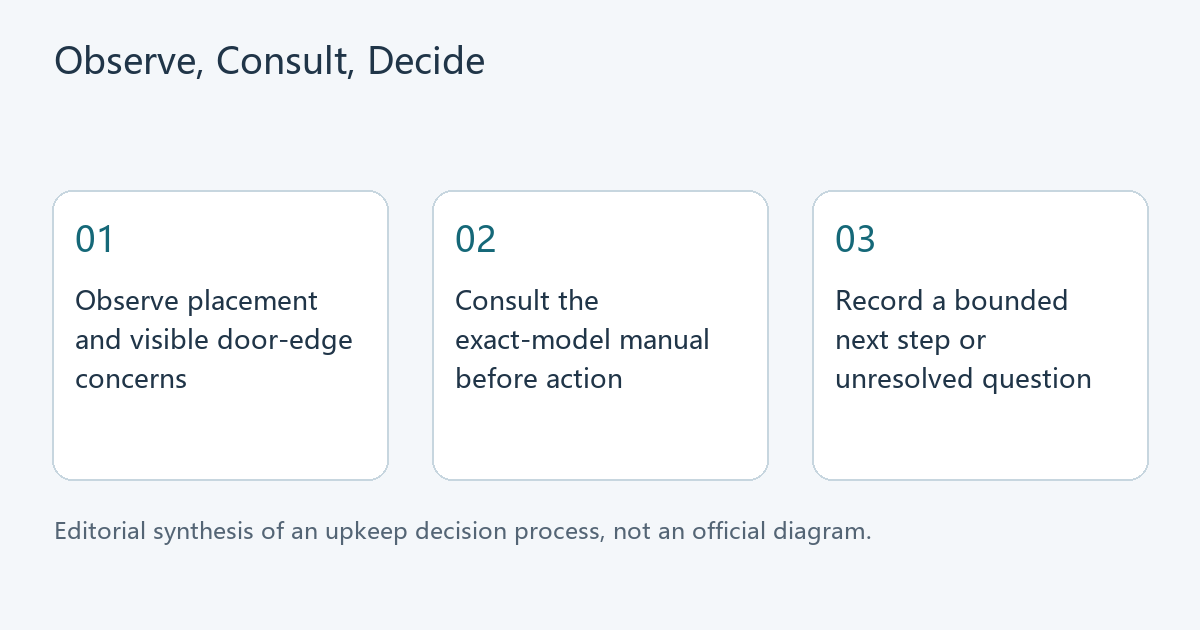
Start with observations, not a shopping list. Check the refrigerator’s surroundings, look for visible concerns around its door seals, and find the instructions for your exact model before planning cleaning. These checks can organize your next step; they do not establish an efficiency problem or show that you need a new refrigerator.
The table below is an editorial decision aid, not a diagnostic procedure. Its purpose is to separate what you can observe from what still needs model-specific instructions or qualified assessment.
The official basis—and its limits
ENERGY STAR’s refrigerator guidance recommends placement away from ovens, dishwashers and direct sunlight, with space behind the appliance. It also advises airtight door seals. For older models, it discusses condenser-coil cleaning and directs readers to the user manual for safe instructions. Those are general recommendations, not an inspection of your refrigerator. This article supplies no universal clearance measurement, cleaning method or maintenance interval.
Observation-to-next-step table
| What you observe | Editorial next step | What remains unresolved |
|---|---|---|
| A nearby heat source or sunlight reaches the refrigerator | Describe the situation and consult the model’s installation instructions before considering a layout change. Do not move the appliance just to complete this check. | The observation alone does not establish an installation defect or quantify energy use. |
| A visible gap, damaged-looking area or other concern at the door edge | Record where you see it. Consult the model’s care instructions; if the concern remains unclear, ask for assessment rather than choosing parts yourself. | A visual observation does not confirm whether the seal is airtight or identify the cause. |
| You are unsure whether coil cleaning applies | Find the exact model’s manual and check whether it provides an owner cleaning procedure. Leave the task unfilled if instructions are missing or unclear. | The general guidance does not establish component access or a safe procedure for your model. |
Use a three-step check without turning it into repair work
- Observe only what is readily visible. Write down the location of each concern. Keep this pass separate from moving the refrigerator, removing covers or reaching into concealed spaces. A useful note is specific enough to revisit without guessing what you meant.
- Match the appliance to its instructions. Record the model identifier if it is already accessible, then compare it with the manual you have. A manual for a similar-looking appliance is not the evidence this checklist requires. Do not substitute a generic cleaning video for missing model instructions.
- Choose one bounded next step. That might be reading an installation section, recording a question for the manufacturer, or arranging qualified help. If a task requires disassembly or electrical work, it is outside this article. An unresolved question is an acceptable outcome.
This sequence deliberately separates inspection from action. Finding a concern does not oblige you to fix it immediately. Likewise, finding no obvious concern should not be recorded as a passed efficiency test. Keep the conclusion narrow: what you saw, which instructions you found, and what remains unanswered.
A hypothetical example
Illustrative only: A household notices sunlight reaching the refrigerator and an uneven-looking section at one door edge. Its notes list those as two separate observations. Before changing the layout or attempting maintenance, it checks the model instructions and prepares questions about the door. The checklist has produced a plan—not a fault diagnosis, a savings estimate or a replacement recommendation.
Keep a useful record, not a savings claim
Use three headings: observation, instruction consulted, and unresolved question. Under each, record only what you actually know. If you later take an instructed action, add what changed visibly rather than assigning an energy-saving percentage. This article contains no measurements that could support such a percentage.
You do not need to complete every possible maintenance task to finish the checklist. Completion means each concern has a documented next step or is explicitly left unresolved. That makes the record useful without turning uncertainty into a purchase decision.
Source check and refresh triggers
Source check date: October 7, 2026. This article uses supplied, captured official text, not a live service, availability check or firsthand test. The relevant excerpt is truncated, and no model-specific manual was supplied. An ambiguous ambient-temperature instruction in that excerpt is excluded rather than silently corrected. Refresh this guidance if the official wording changes or before adding model-specific procedures. It does not assess food safety or cooling faults.

