
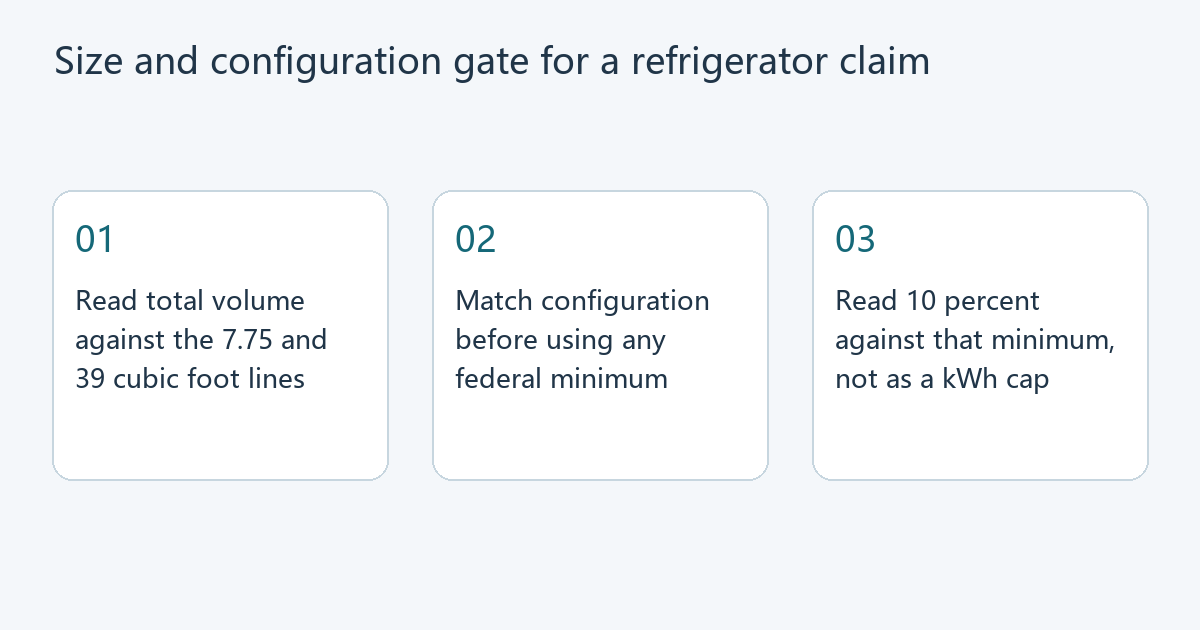
An ENERGY STAR mark does not by itself show that a refrigerator is inside the size and configuration gate. On the criteria page captured for this check, consumer refrigeration criteria changed on August 5, 2021. Both the under-7.75-cubic-foot band and the 7.75-cubic-foot-and-larger band are written as 10 percent less measured energy use than the minimum federal efficiency standards. Total refrigerated volume over 39 cubic feet is not eligible. The federal minimum depends on size, configuration, and functionality, so that shared 10 percent is not one kilowatt-hour cap.
Use this only as a criteria gate based on captured documents. It does not measure annual energy use, compare refrigerants, check cabinet fit, or confirm recycling pickup, and it is not a live listing or a verified availability check.
What the August 5, 2021 criteria page states
The ENERGY STAR key product criteria page says criteria for refrigerators, refrigerator-freezers, freezers, and coolers changed on August 5, 2021. In the captured text, the 7.75-cubic-feet-or-larger line appears twice and the under-7.75 line appears once. Each line says 10 percent less measured energy use than the minimum federal efficiency standards. The capture does not assign those repeated lines to two different percentages.
Products that meet the definition of a refrigerator, refrigerator-freezer, or cooler, including compact and built-in products, are eligible. Products with total refrigerated volume exceeding 39 cubic feet are not eligible. Wine refrigerators and other products that do not meet the definition of an electric refrigerator or electric refrigerator-freezer are not eligible. A product that does meet the cooler definition is a separate eligibility question and is outside this refrigerator gate.
Under the National Appliance Energy Conservation Act, the U.S. Department of Energy sets maximum energy consumption standards. The page says those standards depend on size, configuration, and functionality, and it names side-by-side, top freezer, bottom freezer, single-door refrigerators, built-in refrigerators, chest and upright freezers, and several cooler classes. This capture does not include the numeric federal formula for any class.
Decision table: what 10 percent can and cannot show
| Check | Captured official point | What a shopper can conclude | What remains unresolved |
|---|---|---|---|
| Criteria date | The page states a change on August 5, 2021. | Use that date as the criteria version in this capture. | A later revision would replace this gate. |
| Under 7.75 cubic feet | 10 percent less measured energy use than the federal minimum. | The percentage test is stated for this smaller band. | The minimum still depends on configuration. No kilowatt-hour figure is here. |
| 7.75 cubic feet through 39 | The same 10 percent comparison is stated for 7.75 cubic feet or larger, and volume over 39 is excluded. | Crossing 7.75 cubic feet does not, in this text, change the percentage. | Volume in range does not prove the model meets the measured-energy test. |
| Over 39 cubic feet | Total refrigerated volume above 39 cubic feet is not eligible. | Volume alone can rule a product out. | A low energy claim does not remove that exclusion in this text. |
| Configuration | DOE standards depend on size, configuration, and functionality. | Name the configuration before comparing models. | Side-by-side, top-freezer, and bottom-freezer minimums are not printed as numbers here. |
| Product definition | Defined refrigerators, refrigerator-freezers, and coolers can be eligible. Wine refrigerators outside the electric refrigerator definition are not. | Match the product type before applying the 10 percent line. | This article does not decide cooler certification. |
Separate the 10 percent test from nearby claims
The ENERGY STAR refrigerators product page says certified refrigerators are about 9 percent more energy efficient than models meeting the federal minimum. That is not the criteria sentence. One page says "about 9 percent more energy efficient." The criteria page says "10% less measured energy use." This check does not merge those wordings. The product page also says the most energy-efficient models are typically 16 to 20 cubic feet and that top-freezer models tend to use the least energy. Those are shopping notes, not the 7.75-cubic-foot threshold or the 39-cubic-foot cap.
The yellow EnergyGuide is a different label. The FTC EnergyGuide guide says the label shows appliance energy use and that the cost figure is only an estimate based on typical use and a national average energy price. Local price and how you run the appliance change the cost. ENERGY STAR's label difference page says EnergyGuide estimates annual consumption and rank, while ENERGY STAR marks products that meet EPA guidelines, and only manufacturers that independently certify performance may use that label. The blue mark routes you to the criteria. It does not replace the volume reading or the configuration-specific minimum.
EPA's page on how a product earns the label says products qualify by meeting specification requirements, and that a category market share of 50 percent or higher generally prompts consideration of a revision. That is a program principle, not evidence that the August 5, 2021 refrigerator text has been replaced.
Labeled hypothetical examples
Example A, volume only. Suppose a listing says 18 cubic feet, top freezer, and shows an ENERGY STAR mark. Eighteen is at least 7.75 and not above 39, so these volume lines do not exclude it. Editorial inference: "10 percent" is still not a fixed annual kilowatt-hour limit, because the top-freezer federal minimum is not in this capture. The 16-to-20-cubic-foot note may describe the size, but it is not the eligibility test.
Example B, volume exclusion. Suppose total refrigerated volume is listed as 42 cubic feet. The criteria text says products exceeding 39 cubic feet are not eligible. A percentage claim would not change that volume rule on the captured page.
Example C, smaller band. Suppose a compact model lists 6 cubic feet and meets the refrigerator definition. It falls in the under-7.75 band, where the capture still states a 10 percent reduction versus the federal minimum. Nothing in the capture makes that percentage looser or stricter than the larger band. Configuration still has to match.
Source check, limits, and refresh triggers
Sources were checked on 2026-10-21. If ENERGY STAR revises the criteria date, the 7.75 or 39 cubic foot lines, or the 10 percent wording, or if DOE changes a configuration-specific minimum, this gate needs a new source check. The repeated 7.75-or-larger line is also a reason to reread the criteria table before treating any class as having its own percentage.
No model was measured for this article, and no certificate or product-finder row was confirmed. Numeric federal standards and measured energy results were not in the excerpts. The decision table is an editorial synthesis, not an official ENERGY STAR diagram.

