
On this page
HEPA filter efficiency
EPA describes HEPA as a pleated mechanical air filter. Its statement is theoretical: this filter type can remove at least 99.97% of airborne particles at 0.3 microns. That size represents the most penetrating particle size, not a lower capture-size limit; larger and smaller particles are trapped more efficiently. This is a filter-level explanation, not a measured result for whichever appliance carries the label. EPA definition
Whole-unit particle delivery
EPA uses particle CADR—clean air delivery rate—to guide room selection. Higher CADR means more particles filtered and a larger area served; it is not the HEPA filter's efficiency percentage. EPA guide
Different measurement scopes
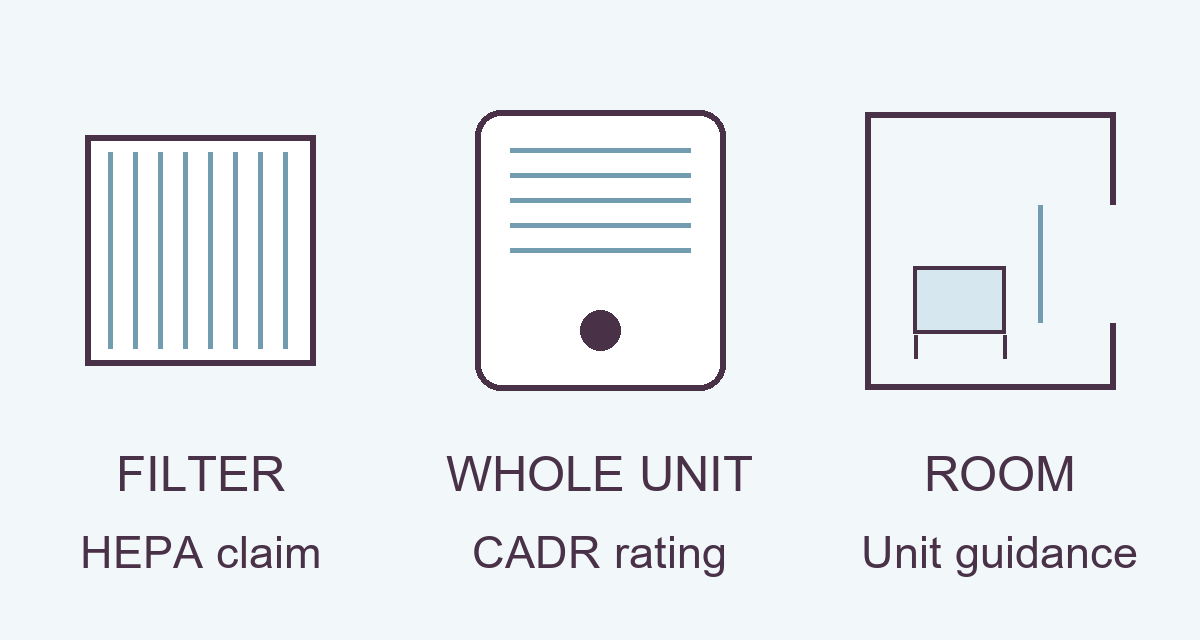
The filter, whole unit and room are different measurement scopes. Editorial inference: a component-efficiency statement cannot substitute for whole-unit and room-selection evidence. HEPA definition; unit guidance.
The documentation still needed
Ask the seller or manufacturer for the particle CADR and room-size guidance for the exact model. If only a HEPA percentage is available, record room coverage as unknown rather than converting it to square feet. This is an editorial purchasing prompt based on EPA guidance.

