
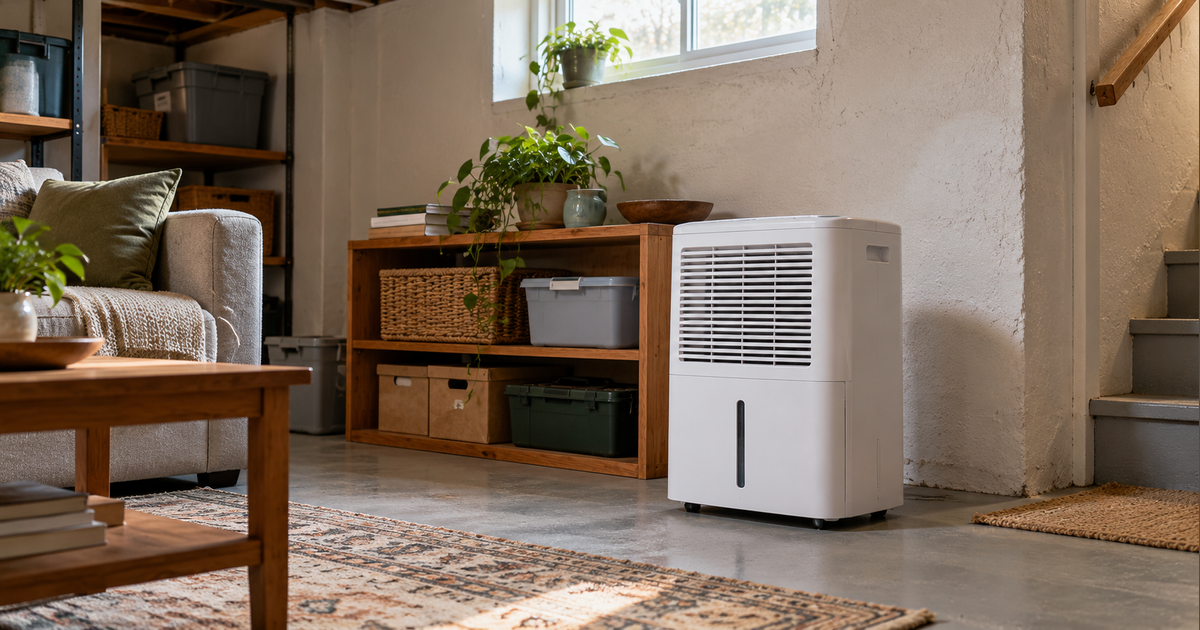
Choose a dehumidifier in two stages: first establish the space and installation requirements, then compare capacity and efficiency separately. A large moisture-removal number does not, by itself, establish better energy efficiency. Before choosing, resolve where the appliance will work, where collected water will go and whether its operating specifications suit the space. For a ducted whole-home system, take the sizing and installation questions to an HVAC professional.
Capacity and efficiency answer different questions
ENERGY STAR defines capacity as moisture removed in pints per 24 hours under specified ambient conditions. Integrated Energy Factor, or IEF, measures efficiency in liters per kilowatt-hour and accounts for dehumidification and standby or off modes. Capacity describes removal capability; IEF relates that capability to energy use. The captured official criteria identify Version 6.0 requirements as effective October 1, 2025.
Editorially, treat these as separate comparison columns. Do not let a prominent capacity figure stand in for an efficiency figure, or assume either number predicts your electricity bill. If a listing omits the rating conditions or IEF, mark that information as missing rather than filling the gap with a seller’s general description.
A decision table to complete before buying
The questions below are editorial purchasing prompts, not a sizing formula or model ranking.
| Decision | Record before comparing | Pause when |
|---|---|---|
| Intended space and ducting | List the spaces you want served and whether you are considering a ducted installation. | The proposed installation is unclear; request a documented plan. |
| Capacity | Write down the rated pints per 24 hours and the stated conditions together. | A coverage claim is offered without enough information to assess suitability. |
| Efficiency | Give IEF its own column, separate from capacity and purchase price. | The comparison substitutes a large removal number for an efficiency rating. |
| Water disposal | Choose a realistic emptying routine or identify the intended drain destination. | The arrangement depends on an unconfirmed fitting, pump or installation detail. |
| Cool-space operation | Record expected temperatures and the model’s documented operating range. | The specification does not clearly cover the intended conditions. |
Confirm the practical constraints
The ENERGY STAR buying guide describes portable units as typically serving a room or space, while whole-home units generally use ducts. Portable capacity needs depend on space size and moisture conditions; the supplied evidence does not include the sizing charts.
The same guide describes buckets on most portable units, hose connections on some, and drains on most whole-home systems. It directs whole-home drainage installation to an HVAC professional. For spaces below 65°F, it advises considering a low-temperature-specified product because coil frost can impair performance.
Turn those points into questions for the particular appliance, not assumptions about the whole category. Ask what drainage equipment is included, what additional equipment the proposed arrangement needs and which manufacturer instructions support it. An unresolved drainage or temperature question is a reason to pause the comparison, even when the advertised efficiency looks attractive.
A hypothetical comparison
Hypothetical example: A household has shortlisted two portable units. One has a higher removal rating; the other has a higher IEF. Rather than declaring either the winner, the household first asks whether each meets its documented capacity requirement. It then compares efficiency among suitable options and checks drainage and temperature specifications. This illustrates a decision sequence, not tested performance or a savings estimate.
Keep a short purchase record
- Save the exact model identifier and the documents supporting each comparison entry.
- Separate confirmed specifications from unanswered seller questions.
- For whole-home equipment, request professional sizing and an installation proposal before committing.
- Reopen the comparison if the intended space, drainage plan or operating conditions change.
Evidence and maintenance
Both linked ENERGY STAR pages were captured on October 23, 2026, UTC. This is source-based guidance, not firsthand testing or a live availability check. No model manuals or household measurements were supplied, so this article cannot specify a required capacity or running cost. Refresh the guidance if official criteria change, and obtain model-specific documentation before purchase. Editorial maintenance owner: nohoa3.

