
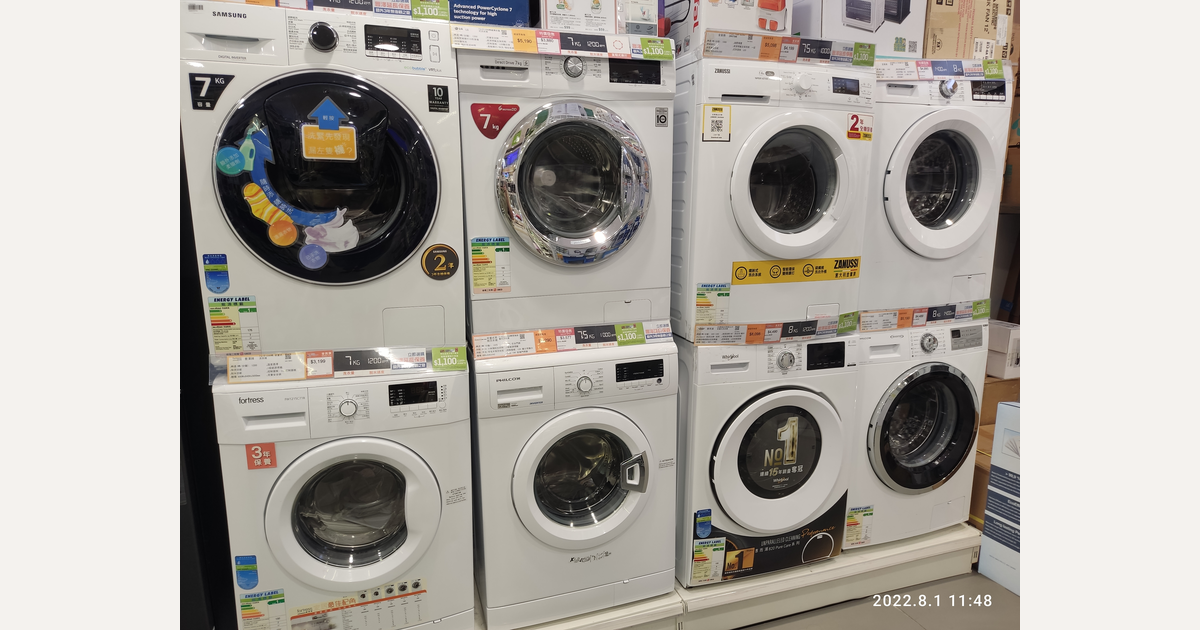
Do not stop at front-load versus top-load. On the ENERGY STAR clothes washers page, certified front-load washers use about 50 percent less energy and water than a top-load agitator washer, and they are still about 25 percent more energy- and water-efficient than a top-load impeller washer. A second ENERGY STAR page, which washer to choose, states a different agitator comparison: about 45 percent less energy and 50 percent less water, while also saying front-load washers are 25 percent more energy- and water-efficient than impeller washers. Those are category comparisons. The purchase still depends on the exact model’s IMEF, IWF, drum capacity, residential eligibility, and EnergyGuide annual estimates.
Check the loading style against the documented ranking
An agitator is a central post that twists in a full tub. An impeller is a low-profile cone or disc in place of that post. A front-load drum uses side paddles, rotation, and gravity to tumble clothes through a smaller amount of water, and it rinses with repeated spray rather than a full-tub soak. ENERGY STAR presents impeller top-loaders as more energy- and water-efficient than traditional agitator top-loaders, and front-loaders as the most efficient of the three. “Top-load” is therefore two styles, not one class.
The two official percentage pairs do not say the same thing about agitators. Editorial practice here is to write down both statements and not average 45 and 50. Also keep separate baselines apart. Certified washers as a group are described as using about 20 percent less energy and about 30 percent less water than regular washers, with about $530 in energy-cost savings over the product lifetime, and full-sized certified washers are described as using 14 gallons per load compared with 20 gallons for a standard machine. Those class figures are not the front-load versus agitator or impeller ranking, and they should not be stacked on top of it.
Record IMEF and IWF from Product Finder
The clothes washers page says the largest savings come from a high Integrated Modified Energy Factor and a low Integrated Water Factor, and that both values are listed for each model in Product Finder. On the key product criteria page, residential IMEF has been the energy metric since 7 March 2015. It is drum capacity divided by the sum of machine electricity, hot-water energy, energy to remove remaining moisture, and combined low-power energy, in cubic feet per kilowatt-hour per cycle. Higher is more efficient. IWF, used for residential washers since the same date, is total weighted per-cycle water use divided by capacity. Lower is more water-efficient. The same page says IMEF or IWF may not appear on the federal EnergyGuide label. Commercial washers use Modified Energy Factor (MEFJ2) as of 5 February 2018; that metric omits the low-power term. A household buying a residential machine should not substitute MEFJ2 for IMEF.
Record EnergyGuide annual energy and cost as estimates
The criteria page says the EnergyGuide label on residential clothes washers shows annual energy consumption and cost built from IMEF or MEFJ2, average cycles per year, and the average cost of energy. The Federal Trade Commission says that cost is only an estimate. ENERGY STAR’s label comparison adds that the dollar amount uses the national average cost of electricity, while local rates and the household’s energy source change the bill. The yellow label is still useful for comparing similar models beside each other. If the label is missing, the FTC says to look inside the appliance or on the seller’s or manufacturer’s website.
Product Finder’s own annual-energy field is a different cut of the data. Its field description, captured from Product Finder metadata, says estimated annual energy use includes the washer and electric water heating, is based on 295 loads a year under the Department of Energy test procedure in 10 C.F.R. Part 430 Appendix J2, and, unlike IMEF, does not address moisture removal that would reduce dryer energy. Estimated annual water use on that same description also uses 295 loads. The clothes washers page separately says the average American family washes about 300 loads a year. Use 295 as the stated basis of those annual estimate fields, and about 300 as the program’s household-average statement. They are not one measured total. Look up the model on the certified clothes washers results list; this article does not contain a live row.
Confirm capacity and the eligibility notes that apply
The criteria page limits ENERGY STAR certification to front- and top-loading clothes washers with capacity greater than 1.6 cubic feet and less than 8.0 cubic feet, excluding residential clothes washers with heated drying functionality and top-loading commercial clothes washers. The clothes washers page says only front- and top-loading washers that meet the residential or commercial definitions, with capacity greater than 1.6 cubic feet, are eligible, and it also says combination all-in-one washer-dryers with air-only drying and laundry centers can be eligible when they meet the washer and dryer criteria. The captured pages do not reconcile those boundaries. If a model is near 1.6 or 8.0 cubic feet, has heated drying, or is sold as commercial, leave certification unresolved until the current criteria and the Product Finder row agree.
Check space, stackability, and usual load size
Certified models are sold in more than one width and drum capacity, including stackable, under-counter, and combination forms. That is availability across the category, not a promise that the machine on the floor fits the closet. The FTC’s shopping guidance says to measure a space that lets the door or lid open fully and leaves clearance for safe ventilation. Match the drum to whether the household usually runs small or large loads. Loading style does not answer the tape-measure question.
Keep gentleness and extra drum space off the efficiency line
The clothes washers page says agitators can be rough on clothes, that certified washers lift and tumble laundry, and that many models can wash silk, wool, and other hand-washables. It also says that omitting a bulky agitator leaves more usable space, especially for larger items, which can mean fewer loads. The front-or-top page adds that front-load washers spin faster and extract more water, which can reduce drying time and energy, and it illustrates capacity as about 15 to 20 pounds in 4.5 cubic feet. Treat the spin comment as one reason IMEF includes remaining-moisture energy, and treat 4.5 cubic feet as that page’s illustration. Neither gentleness nor a larger usable drum is a substitute for the model’s IMEF, IWF, or EnergyGuide figures. The same page refers to studies on microfiber shedding; the captured excerpt does not name those studies, so this article does not use shedding as a buying result.
Store checklist
- Write the configuration: front-load, top-load agitator, or top-load impeller. Note the clothes washers page (about 50 percent less energy and water than an agitator; about 25 percent more efficient than an impeller) and the front-or-top page (about 45 percent less energy and 50 percent less water than an agitator; 25 percent more efficient than an impeller). Do not average them, and do not add the separate 20 percent / 30 percent / 14-gallon class statements onto that rank.
- From the model’s Product Finder row, copy IMEF and IWF. Prefer the higher IMEF and the lower IWF when comparing residential models. Confirm you did not copy a commercial MEFJ2 into the IMEF blank.
- From the yellow EnergyGuide, copy annual energy use and the annual dollar estimate. Mark the dollar figure as a national-average estimate. If you also copy Product Finder annual energy or water, mark those as 295-load estimates, and remember that this annual energy figure does not include the dryer benefit inside IMEF.
- Copy drum capacity in cubic feet. Pass the criteria-page band only if it is greater than 1.6 and less than 8.0, and the machine is not a heated-drying residential washer or a top-loading commercial washer. If the product-page wording about commercial definitions or combination units is the only text that seems to fit, leave eligibility blank.
- Measure door or lid swing and ventilation clearance. Record whether the seller’s sheet for this model says stackable, under-counter, or combination, and whether your usual loads are small, large, or mixed.
- Optional notes only: gentler tumble action, silk or wool cycles, and usable drum without an agitator. Do not accept those notes in place of IMEF, IWF, or the EnergyGuide estimate.
A hypothetical aisle note with blank fields
Hypothetical example, not a store visit or a test: a household alternates bulky bedding with small midweek loads and is looking at one certified front-load washer and one certified top-load washer. No brand, kilowatt-hour, gallon, or price belongs in the blanks until the shopper reads that model. If the front-load row has both the higher IMEF and the lower IWF, the category ranking and the model row point the same way on energy and water. If one metric favors the impeller model and the other favors the front-load model, the style ranking does not finish the choice.
- Model identifier: ______
- Loading style (front-load, agitator, or impeller): ______
- Capacity, cubic feet: ______
- IMEF: ______
- IWF: ______
- EnergyGuide annual energy: ______
- EnergyGuide annual cost, national-average estimate: ______
- Product Finder annual energy and water, if shown, marked as 295-load estimates: ______
- This model stated as stackable, under-counter, or combination: ______
- Usual loads (small, large, or mixed) and whether the measured opening fits: ______
Source check and what would require a refresh
Sources were checked on 4 November 2026. This page is an editorial checklist, not a live Product Finder query, a certification lookup, or a statement that any model is in stock.
- ENERGY STAR clothes washers — configuration ranking, IMEF and IWF direction, class savings, gallons per load, gentleness, drum space, and one eligibility wording.
- Front-load or top-load — the 45 percent / 50 percent agitator split, the 25 percent impeller comparison, wash action, spin, and the 4.5-cubic-foot illustration.
- Key product criteria — IMEF, IWF, and MEFJ2 definitions, the 1.6 to 8.0 cubic-foot band, exclusions, and the statement that EnergyGuide may omit IMEF and IWF.
- Product Finder field descriptions and the results list — 295-load annual energy and water definitions. No model row was copied.
- FTC EnergyGuide guidance and EnergyGuide versus ENERGY STAR — estimate, national average price, and how the two labels are meant to be used together.
- How a product earns the label — performance plus efficiency, and the idea of recovering a higher purchase price through bill savings within a reasonable period. A high market share can prompt EPA to consider a tighter specification, so today’s bar is not permanent.
Refresh this checklist if EPA changes the front-load, agitator, or impeller percentages, the IMEF or IWF definitions, the capacity window, or the EnergyGuide method, or if the two eligibility wordings are replaced by one current rule. Household electricity rates were not supplied, so no local annual cost is calculated.

