
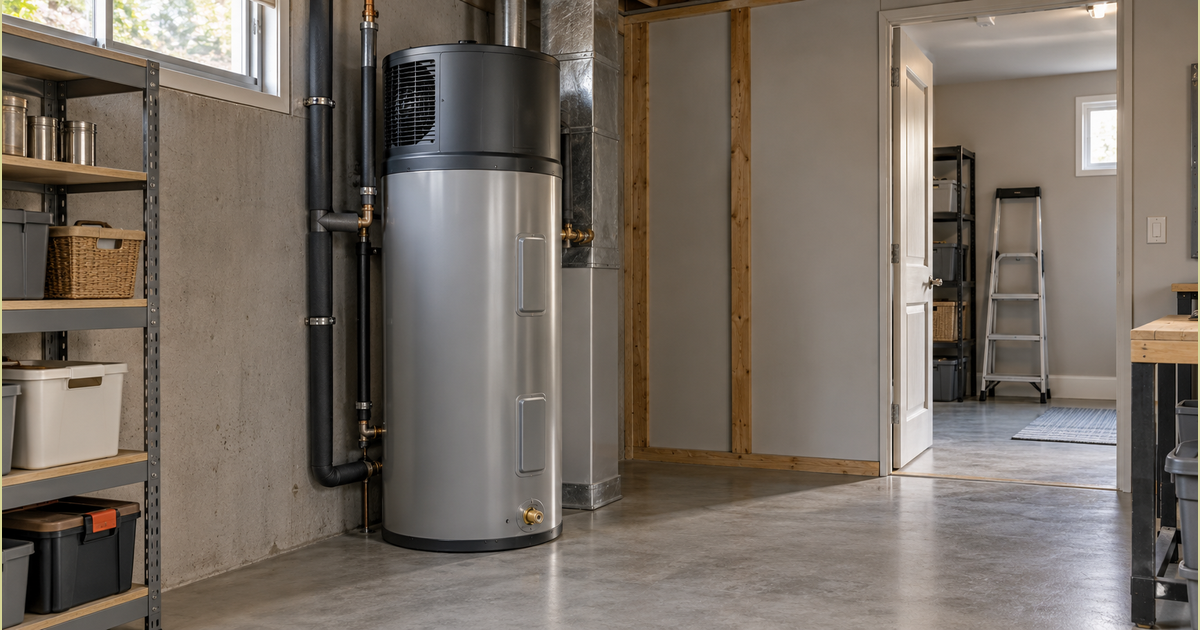
Before buying a heat-pump water heater, ask a qualified installer to assess the proposed location against the exact model’s instructions and applicable local requirements. A room description alone cannot settle suitability.
Hypothetical example: You are considering a utility room beside a bedroom. Put cooler exhaust air, sound and unanswered technical questions into the purchase discussion now—not after choosing the appliance. This example does not establish that the room is suitable.
Source guidance and its boundaries
ENERGY STAR’s Residential New Construction design guide discusses adequate air access, installation and service space, operating noise, and cooler, drier exhaust air. It also directs readers to model instructions and local codes. Its new-home-program context is not a universal installation specification. See the ENERGY STAR design considerations.
A room-to-installer question planner
This table is an editorial note-taking aid. Record ordinary household observations separately from technical answers. An empty answer means unresolved—not acceptable by default. Do not inspect wiring, open equipment or modify the room to complete it.
| Planning item | Your note | Installer question |
|---|---|---|
| Room and occupants | Name the room, adjacent rooms and their usual occupancy. | How would sound and cooler air affect this location? |
| Air and access | Describe the doorway and nearby stored objects. | Which exact-model air-access and service-space instructions apply? |
| Condensate | Leave the technical arrangement unresolved. | What condensate arrangement does this model need here? |
| Electrical suitability | Leave compatibility unresolved. | What electrical assessment is needed for this model and site? |
| Basis for the answer | Record the candidate model, or write “not chosen.” | Which manual and local requirements support your assessment? |
The supplied excerpts do not establish condensate-drainage or electrical requirements. Those rows deliberately request answers rather than provide specifications.
A concise handoff brief
For the hypothetical bedroom-adjacent room, begin with the household concern: “This is our proposed location, and the next room is used for sleeping.” Then organize the response under four headings:
- Observed: What you can describe about the room and household routines.
- Proposed: Candidate location and model, clearly marked as undecided where necessary.
- Confirmed: The installer’s answer, its supporting document and any stated conditions.
- Still open: Each unanswered question, who will resolve it and when.
Keep observations and confirmations in separate fields. A household preference should not quietly become a technical conclusion, and an installer’s unanswered question should not disappear when comparing purchase quotes.
The purchase checkpoint
Request a written, model-and-site-specific response before committing. If the answer is simply “it fits,” ask which table rows that statement resolves. Carry the remaining questions forward explicitly rather than treating one reassuring answer as approval of the whole plan.
Source date: This article uses ENERGY STAR excerpts captured October 25, 2026, not a live availability check. The home-upgrade excerpt includes a tax-credit window ending December 31, 2025; it does not establish a 2026 incentive. Revisit the assessment if the model, proposed location, applicable requirements or supporting guidance changes.


