
On this page
Quick Answer
To garden on a balcony, start with pots that drain well, fill them with potting mix (not garden soil), and grow what suits your light: leafy greens and herbs manage on four to six hours of sun, while tomatoes, peppers, and beans need six to eight. Water more often than an in-ground garden — pots dry out fast — and start with a few forgiving plants: lettuce, cherry tomatoes, basil, mint, and chives. A small balcony can feed you salads and herbs all season, and it costs little to set up.
If you have a yard as well, our organic vegetable garden guide covers raised beds and in-ground growing; the balcony version below uses the same principles — sun, soil, water — scaled down to pots. And if you want to feed those pots for free, our home composting guide shows how kitchen scraps become soil food, even in a small space.
First, Read Your Balcony
Before you buy a single pot, spend a few days watching your balcony. Note when the sun arrives and when it leaves, and whether the space is shaded by the building above or by a neighbour’s tree. Most vegetables need full sun — about six hours of direct sun a day — and fruiting crops such as tomatoes and peppers do best with six to eight. If your balcony only gets four to six hours, grow leafy crops and herbs instead; they cope, and they still taste like something.
Wind matters more on a balcony than in a yard. High balconies are windy, and wind dries pots out and snaps tall plants. A simple windbreak — a trellis, a row of sturdy pots, a bamboo screen — makes a real difference, and it doubles as a support for climbing beans or peas. Also check the practical things: is there a tap nearby, or will you be carrying water? And is there a weight limit? Wet soil is heavy, so a long row of large pots adds up — check your building’s rules before you load a small balcony with a dozen big planters.
Pots, Soil, and Drainage
Every pot needs a drainage hole. Without one, water pools at the bottom, roots rot, and the plant dies while the top looks fine. If a pot you love has no hole, drill one, or use it as a decorative outer pot with a plainer pot inside.
Use potting mix, not soil from the garden. Garden soil compacts in a pot, drains badly, and can carry pests and weed seeds. Potting mix is light, holds moisture without staying soggy, and is made for containers. A bag of good mix plus a handful of compost is all most balcony plants need — and if you make your own compost, a worm bin fits on a balcony corner, as our composting guide explains.
Bigger pots are more forgiving than small ones. A tomato wants at least a 5-gallon (about 20-litre) pot; lettuce and herbs are happy in much smaller ones. Small pots dry out in a day in summer sun, so if you can only water once a day, choose larger containers and mulch the surface with straw or shredded leaves to hold moisture in.
Vegetables: What Grows Well in Pots
Pick compact varieties, and pick crops for the odds, not the ambition. These are the most forgiving balcony vegetables. Days to harvest are typical seed-packet ranges; your variety and climate will shift them.
- Cherry tomatoes — about 55 to 70 days from transplant. The best balcony vegetable. One plant in a large pot, with a stake or a small cage, crops for months. Buy a young plant rather than starting from seed in year one, and look for a compact or “patio” variety.
- Leaf lettuce — about 30 to 45 days. Loose-leaf varieties can be harvested a few leaves at a time, so one sowing feeds you for weeks. Tolerates as little as four hours of sun and prefers cool weather — sow in spring and again in late summer.
- Bush beans — about 50 to 60 days. Sow directly once the weather is warm. Compact, productive, and they fix their own nitrogen, so they ask little of the soil. Pick often to keep them producing.
- Peppers — about 60 to 80 days from transplant. Need warmth and six or more hours of sun, but a single plant in a medium pot gives a steady supply. Hot peppers are especially productive in small spaces.
- Radishes — about 25 to 30 days. The fastest reward in the garden, and they grow in shallow pots. Sow in cool weather and thin seedlings so the roots have room to swell.
- Zucchini — about 45 to 60 days. Enormously productive, but it needs a large pot and a lot of space — even bush types spread wide. One plant is enough for most households, and only if you have the room.
Skip in year one on a balcony: sweet corn (needs a block of plants to pollinate), pumpkins and melons (they take over), and head lettuce or cauliflower, which are picky about temperature and take months.
Herbs: The Easiest Win on a Balcony
If you only grow one thing on a balcony, grow herbs. They are cheap, they are forgiving, and a handful of fresh basil or mint changes a meal in a way a supermarket packet never does. Fresh herbs go straight into weeknight cooking — our easy plant-based recipes are a good place to use them.
- Basil — needs warmth and sun. The classic balcony herb. Pinch the top regularly to keep it bushy, and it will produce all summer. Plant it after the last frost.
- Mint — give it its own pot. Mint spreads aggressively and will take over a shared planter. In its own pot it is easy and nearly impossible to kill.
- Parsley — sun or part shade. Slow to start from seed, so buy a young plant. Cut outer stems and it keeps producing for months.
- Chives — perennial and tough. Come back year after year in mild climates, and their flowers are edible too.
- Rosemary and thyme — sun lovers that like it dry. Mediterranean herbs that prefer less water than most vegetables, so do not overwater them. They are perennial in warm climates and worth bringing indoors for winter in cold ones.
Watering and Feeding in Pots
Pots dry out far faster than garden beds, especially in sun and wind. In summer, check the soil every day — push a finger an inch in; if it is dry, water. Water deeply until it runs out of the drainage hole, and water at the base of the plants in the morning if you can, so leaves dry before nightfall.
Self-watering pots and a simple drip system on a timer take the daily chore out of it, and they are worth it if you travel. A saucer under a pot catches drips, but do not leave plants standing in water — empty saucers after watering, or roots will rot.
Feed lightly. Potting mix runs out of nutrients after a few weeks, so a liquid feed such as seaweed or compost tea every two to three weeks keeps plants going. A handful of compost worked into the top of the pot does the same job more slowly — and if your household is cutting waste more broadly, our green home guide covers room-by-room ways to live lighter, balcony included.
FAQ
What vegetables grow best on a balcony?
Cherry tomatoes, lettuce, bush beans, peppers, and radishes are the most reliable. They are compact, productive, and cope with containers. Choose compact or “patio” varieties, and give fruiting crops six or more hours of sun.
How much sun does a balcony garden need?
Most vegetables want six or more hours of direct sun a day, and tomatoes, peppers, and beans do best with six to eight. Leafy crops and herbs manage on four to six hours, which makes them the right choice for a partly shaded balcony.
What herbs grow well in pots?
Basil, mint, parsley, chives, rosemary, and thyme all grow well in pots. Give mint its own pot — it spreads aggressively — and keep rosemary and thyme on the dry side.
Can I grow vegetables on a north-facing balcony?
It is harder, but not impossible. A north-facing balcony gets little direct sun, so grow shade-tolerant crops: lettuce, spinach, kale, chard, and herbs such as parsley, mint, and chives. Fruiting vegetables such as tomatoes will struggle there.
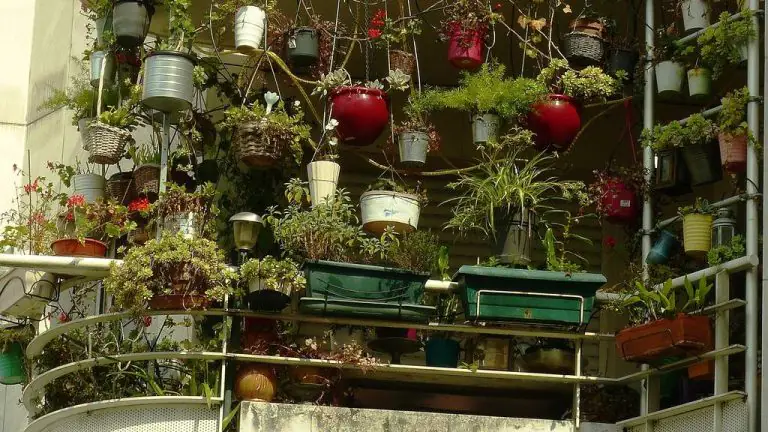
Sources: University extension guidance on container gardening (sun requirements, potting mix, drainage); Royal Horticultural Society (container growing and herb care); U.S. Department of Agriculture (organic production methods). Days to harvest are typical seed-packet ranges and vary by variety and climate; check your seed packet and your local extension service for frost dates. Fact-check date: November 20, 2026. Cover photo: potted plants on a balcony in Paris by FreCha, CC BY-SA 4.0, via Wikimedia Commons.


