
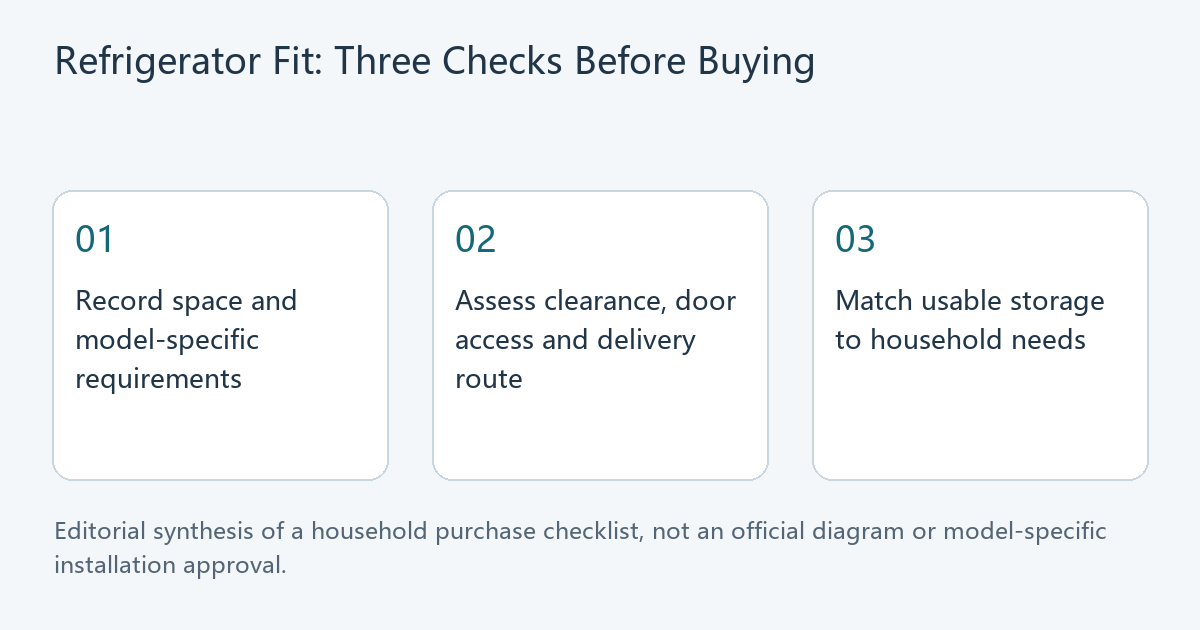
Do not buy on cabinet dimensions alone. Put a refrigerator on your shortlist only after checking installation space, door movement, ventilation requirements and usable storage. Missing measurements mean investigate—not assume it fits. The worksheet below is an editorial decision aid, not confirmation that a particular appliance can be installed.
The Federal Trade Commission’s appliance-shopping guidance says the space must accommodate the appliance, allow its door or lid to open fully and provide enough clearance for safe ventilation. No model-specific dimensions or installation manual were supplied for this article, so there is no universal clearance number to apply.
1. Make one measurement sheet per candidate
Start with the exact model identifier, not just a product-family name. Leave an entry blank when you cannot establish it. Record units consistently and keep the installation document’s revision or date alongside your notes.
- Installation space: Record available width, height and depth. Note where each measurement begins and ends, including cabinets, trim, baseboards and any obstruction.
- Model dimensions: Copy the manufacturer’s dimensions and their definitions. Identify whether the stated depth includes doors and handles, and whether height includes hinges. Do not fill gaps from a product photograph.
- Ventilation: Record the model’s specified clearances and any installation restrictions. Compare them with your space using the document’s measurement references.
- Door movement: Mark the hinge side, nearby wall or cabinet, handle path and the opening needed for ordinary access and drawer removal. Seek model-specific instructions where the required opening is unclear.
- Delivery route: As an additional editorial precaution, list entrance openings, turns, stairs and the kitchen approach. Ask the delivery provider to assess unresolved obstacles; do not assume removing a door is an approved solution.
- Storage needs: List your routine refrigerator and freezer contents, largest containers, shopping interval and occasional peak loads. Keep these separate from exterior measurements.
For each entry, add three fields: your measurement, the candidate’s documented requirement and the unresolved question. This makes a missing specification visible instead of turning it into an optimistic guess.
2. Assign pass, investigate or reject
Editorial decision rule: “Pass” means the evidence supports that particular check. It is not an installation guarantee. “Investigate” means information is missing or ambiguous. “Reject” means a documented requirement conflicts with the proposed arrangement; reconsider only after an acceptable alternative is documented.
| Check | Pass | Investigate | Reject current arrangement |
|---|---|---|---|
| Space and ventilation | Measured space accommodates the model and its documented installation allowances. | Clearances, dimension definitions or an obstruction remain unresolved. | The space cannot accommodate a documented requirement. |
| Door and drawer access | Documented opening needs can be met without interference. | A nearby wall, handle path or drawer-removal requirement needs clarification. | The required opening is blocked, with no documented acceptable alternative. |
| Delivery route | The delivery provider has confirmed the proposed route and method. | An opening, turn or handling method has not been assessed. | The provider identifies an obstacle that prevents the proposed delivery. |
| Household capacity | The documented layout accommodates your routine storage list. | Total volume is known, but relevant shelf or compartment information is missing. | Your essential storage needs cannot be accommodated in the proposed layout. |
Keep a candidate unresolved while any row says investigate. A discount or efficiency label does not supply the missing measurement. If one row fails, identify the specific problem before considering a different model or changing the kitchen arrangement.
3. Choose capacity for your household, not a headline number
ENERGY STAR’s refrigerator guidance recommends an appropriately sized refrigerator and says larger refrigerators generally consume more energy. That supports considering size carefully; it does not establish the right capacity for your household.
Our editorial approach is to compare the storage list with the actual compartment layout. Ask whether your usual containers, freezer items and largest regularly stored objects have suitable places. Treat a total-volume figure as a starting point, not proof that the arrangement works.
Hypothetical example: A household shops weekly and routinely stores one tall pitcher and several wide food containers. Two candidates both clear the installation checks. Rather than choosing the larger one automatically, the household asks for shelf and drawer dimensions and checks those against its storage list. Until that information arrives, capacity remains investigate.
Keep fit and running cost separate
After resolving fit, compare energy use as a separate purchase decision. The FTC explains that EnergyGuide costs are estimates based on typical use and a national average energy price; actual costs depend on use and local prices. Neither an energy comparison nor an efficiency certification answers the physical-fit questions above.
Evidence dates and refresh limits
The supplied package records captures on October 6, 2026 and validity cutoffs on October 7, 2026: 20:13:28.552345 UTC for the FTC excerpt, 20:13:29.027806 UTC for the ENERGY STAR refrigerator overview, 10:10:35.645889 UTC for the criteria page and 10:10:35.989285 UTC for the label explanation. These are package metadata, not evidence of a separate source check. This article uses supplied document excerpts; no independent source check, firsthand testing or live availability check was performed. Refresh expired evidence and reassess the worksheet whenever the exact model, installation instructions, room measurements or household storage needs change.


